How Webmasters Can Monetize a Website With Mondiad Ads: A Research-Backed Playbook
Learning how to monetize a website is about more than adding ads. Successful webmasters first research their niche, verify how ads are delivered to real users, and then choose an advertising platform that matches their audience.
This guide walks through that sequence for webmasters specifically - researching and verifying with Proxies.sx, then monetizing with Mondiad, a self-serve ad network built for publishers who want control over formats, fill rate, and payouts.
Key takeaways for webmasters
- Research pricing, content demand, and the existing ad landscape in your niche before adding a single ad unit
- Verify ad delivery - correct creative, correct geo, no fraud - before scaling traffic or ad spend
- Monetize with an ad network only once you have confirmed the traffic and targeting behind it are real
- Repeat the same three-step pipeline for every new site or geo instead of treating each as a one-off
Step 1: Research the market before you monetize
Market research, for a webmaster, means understanding the pricing, content demand, and existing ad landscape in a niche before deciding how to monetize it. Done well, it turns "which ad network and formats should I use" from a guess into a decision backed by real data.
Price and competitive monitoring
Track competitor pricing, stock levels, and positioning across regions over time. This only works if the data reflects what users in each market actually see - a single vantage point in one country will miss regional pricing differences, promotions, or availability that affect what ad-supported content performs well there.
Proxies.sx provides real 4G/5G mobile IPs across 100+ countries, so a webmaster's research reflects an accurate local vantage point in each market rather than a single skewed one.
Content and audience demand research
Before building content or a new site meant to carry ads, understand what is already ranking and what audiences in that niche actually engage with - including how that varies by geography.
A topic that performs well (and monetizes well) in one market may barely register in another. Running this research from real local IPs, rather than a single fixed location, is what makes geo-specific findings - and the monetization decisions built on them - reliable.
Studying the existing ad landscape
Look at what ad formats, density, and networks competitors in your space are already running. This is the single most useful input for a webmaster deciding how to monetize: it tells you what ad experience a niche's audience is already accustomed to, before you set up your own placements with a network like Mondiad.
Example: researching a travel niche across three markets
A webmaster planning a travel site targeting the US, Germany, and Brazil could use local mobile IPs in each country to check three things before monetizing a single page: which travel topics are already ranking locally, what price points competing sites show local users (fares and hotel rates often differ by region due to dynamic pricing), and which ad formats those competing sites run.
If German competitors lean on native ads while Brazilian ones run heavier push notification volume, that is a direct signal for how to configure ad zones per geo in Step 3 - rather than applying one ad format across all three markets by default.
Step 2: Build and verify before you turn on ads
"Build" here means building an informed site or content strategy - using research to decide what to create, for which audience, in which geo - with monetization in mind from the start. It does not mean lifting content from the sites you researched.
Turning research into a monetization-ready build plan
Use the data from Step 1 to decide what is worth building: which topics, which regions, which content format will carry ads well. This is the difference between adding ad units on assumption and adding them where the traffic and audience fit already justify it.
Verifying delivery before you scale ad spend or traffic
Before scaling anything - traffic, content, or the ad campaigns feeding it - verify it is actually working. Using Proxies.sx's mobile IPs for ad verification confirms that campaigns render the correct creative, in the correct geo, to real users, without fraud sitting in the middle.
For a webmaster, scaling traffic or spend on top of unverified delivery just scales the revenue leak along with the traffic.
Step 3: Monetize with an ad network built for webmasters
Once research has validated real demand and verification has confirmed clean delivery, monetizing becomes a lower-risk next step rather than a guess layered on top of guesses.
What is website ad monetization?
Website monetization is the process of generating revenue from website traffic through advertising. For publishers that rely on display advertising, success depends on attracting valuable traffic and choosing the right ad formats.
This is where Mondiad fits in.
Matching ad formats to your research data
Use what you learned in Step 1 about the existing ad landscape in your niche to choose formats and placements your audience is already used to.
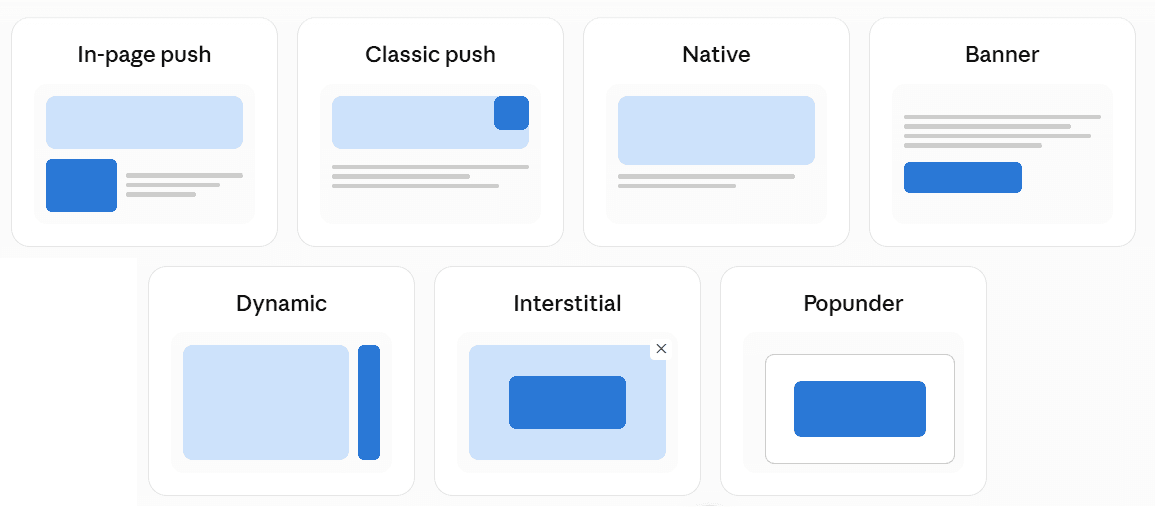
Mondiad's multiple ad formats give webmasters room to match the format to what the research showed the audience responds to, rather than defaulting to one format across every site.
Getting started without losing momentum
Mondiad lets webmasters adjust ad zones and monitor performance directly, so placement and fill-rate decisions stay in your control.
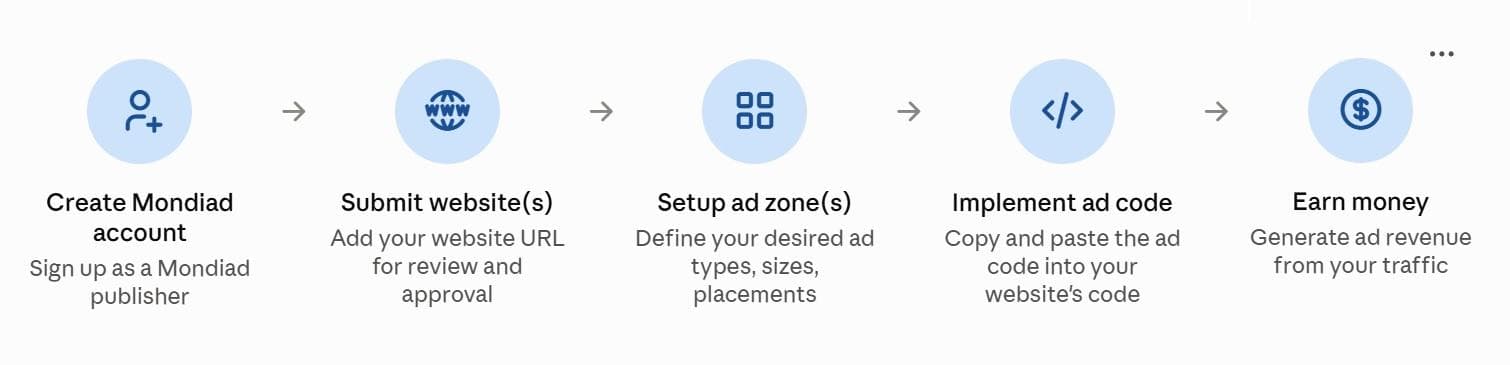
Getting to that point does not take long either - onboarding runs as a short documented flow: create an account and validate the email, submit your site, prove you own the domain (Mondiad accepts an inline code snippet, an uploaded file, a DNS TXT record or a CNAME), set up ad zones, then paste the generated script into your page head. Every site is manually reviewed, but Mondiad states that approval takes under an hour during working hours and that there is no minimum traffic requirement, so a webmaster who just finished Step 2 can move straight into monetizing without a drawn-out approval process.
Revenue and payments that respect a webmaster's time
Fast, flexible payouts get money into a publisher's hands quickly rather than tying it up in a slow, rigid cycle - a webmaster who just spent two steps validating and verifying their traffic should not have to wait weeks to see the return.
Mondiad advertises a 100% revenue share for new publishers for 20 days, a 10 dollar minimum cashout (one of the lowest on the market) and cashouts you can request daily. Two details are worth knowing before you plan around them: the $10 floor applies to PayPal, Paxum, Capitalist, Litecoin, Ripple, Stellar and Dai, while Payoneer, USDT and USDC start at $50, the major chains at $150 and Wire at $1,000; and the 24 to 48 hour window is an average on requested payouts, with Mondiad noting longer delays over weekends and holidays. Our own Mondiad review sets out the full method-by-method minimums.
Repeating the pipeline across new sites or geos
Once one property is researched with Proxies.sx, built, verified, and monetized with Mondiad, the same three steps repeat for the next site or region a webmaster wants to add ads to.
| Step | Goal | Tools | Result |
|---|---|---|---|
| Research | Understand demand | Proxies.sx | Better strategy |
| Verification | Confirm clean delivery | Proxies.sx | Less wasted spend |
| Monetization | Generate revenue | Mondiad | Higher earnings |
FAQ
Why should a webmaster research a market before monetizing a site?
Research replaces assumptions with evidence - showing what content, or ad formats, already work in a niche, and in which regions, before you set up ad zones around it. Tools like Proxies.sx make this possible by providing real local IPs across 100+ countries.
Can a webmaster run research, building, and monetization on an ongoing basis, not just once?
Yes. Markets and audiences shift, so research and verification are typically recurring processes, not one-time setup steps - especially for webmasters actively scaling traffic or adding new sites.
Which ad formats should a webmaster start with when monetizing a new site?
The formats that fit best depend on what Step 1's research shows the niche's audience already responds to. On the publisher side Mondiad currently serves in-page push, classic push, native, banner, dynamic and interstitial ads, plus popunders through its sister network PopCash, so webmasters can match format to audience rather than defaulting to one format across every site.
Ready to monetize what you have built and verified?
Monetizing a website successfully requires more than placing ads. Researching your niche, and selecting the right monetization platform, help reduce risk and improve long-term revenue. By repeating this process whenever you expand into new markets or launch additional websites, you can build a more scalable monetization strategy.
Monetize with MondiadResearch and verify from inside the market
Steps 1 and 2 both depend on seeing what a real local user sees. Real 4G/5G mobile and residential exits across 100+ countries let you check competitor pricing, local search results, and whether your own ad units render the right creative in the right geo. $4/GB dropping to $2.40/GB at volume, GB never expire, and endpoints are free - so one endpoint per market costs nothing extra.
Related reading
This article was contributed by Mondiad and published by PROXIES.SX, and the Mondiad claims in it were fact-checked against Mondiad's own FAQ, publishers page and blog before publication. The withdrawal minimums, the 24-48 hour average processing window, the manual site review under one hour and the absence of a minimum traffic requirement are all sourced from those pages and are set out in full in our Mondiad review. The 100% revenue share for a new publisher's first 20 days appears only in a Mondiad blog post with no published fine print, so treat it as a promotional claim and confirm the current terms at sign-up. The submitted draft described onboarding as three steps and listed four ad formats; both have been corrected here to the flow and the publisher format range Mondiad actually documents. The travel-niche example is illustrative rather than measured data. Screenshots are supplied by Mondiad. Outbound links to mondiad.com use rel="nofollow sponsored noopener noreferrer".