TikTok Ads Creative Testing Across GEOs: A Practical Workflow for Affiliate Marketers
TikTok Ads can perform very differently from one country to another. A creative that works well in the United States may not get the same reaction in Germany, Brazil, or Southeast Asia. For affiliate marketers, this makes creative testing more than a simple process of making more videos. It requires a clear workflow for researching local markets, organizing browser environments, testing different angles, and tracking results properly. So this article explains how affiliate teams can build a practical TikTok Ads creative testing workflow across multiple GEOs.
Why TikTok Ads perform differently across countries
TikTok is a content-driven platform, and content is strongly shaped by local culture, language, and user expectations. Even when the same offer is promoted in different countries, the way users react to the ad can vary a lot. That is why multi-GEO creative testing should look at more than the video itself. It should consider the full context behind each market.
1. Local culture shapes user reactions
Different markets respond to different types of messages. In one country, users may react well to direct discount-driven ads. In another, the same message may feel too aggressive or too sales-focused.
Some audiences prefer personal stories and UGC-style videos because they feel more natural and relatable. Others may trust clear product demonstrations, expert-style explanations, or detailed proof before they click. The same product can work in several countries, but the emotional angle often needs to change.
2. Localization is more than translation
Language also plays a major role in TikTok creative testing. Translating an English ad word for word is rarely enough. A message can be technically correct but still sound unnatural to local users.
Good localization means adjusting the tone, hook, call to action, and even the situation shown in the video. For example, an ad for a skincare product may focus on visible before-and-after results in the United States, dermatologist-style credibility in Germany, and a more emotional self-confidence angle in Brazil. The product is the same, but the way users connect with the message is different.
3. The landing page experience must match the market
Creative testing should not only focus on the TikTok video. The landing page experience also needs to make sense for each GEO.
Different countries may see different prices, currencies, forms, shipping terms, payment methods, or localized copy. If the ad message and the landing page experience do not match, users may click but fail to convert. A strong TikTok creative works best when the full journey, from the first hook to the final landing page, feels consistent for the target market.
How to build a multi-GEO TikTok Ads creative testing workflow
Step 1: Choose the right GEOs before testing
A common mistake in multi-country advertising is trying to test too many markets at once. This usually spreads the budget too thin and makes the data difficult to understand.
Instead, affiliate teams should start with 2 to 4 priority GEOs. These markets should be selected based on offer type, payout, traffic cost, language difficulty, and the team's ability to produce localized creatives.
For example, Tier 1 markets such as the US, UK, Canada, and Australia may offer higher payouts, but they also come with higher competition and ad costs. European markets such as Germany, France, Spain, and Italy may work well for ecommerce, software, or finance-related offers, but they require stronger localization. LATAM and Southeast Asian markets may be better for mobile apps, surveys, low-ticket ecommerce, or lead generation campaigns.
| GEO type | Example markets | Good for | Main challenge |
|---|---|---|---|
| Tier 1 | US, UK, CA, AU | High-payout offers, SaaS, finance | Higher competition and ad costs |
| Europe | DE, FR, IT, ES | Ecommerce, apps, software | Language and localization |
| LATAM | BR, MX, CO | Mobile apps, ecommerce, lead generation | Payment habits and local messaging |
| Southeast Asia | PH, TH, VN, ID | Surveys, mobile-first offers, low-ticket products | Fast trends and high creative volume |
Step 2: Research TikTok creatives by market
Before creating new ads, teams should spend time researching what already works in each market. This does not mean copying competitors. It means identifying patterns.
When reviewing TikTok ads or organic content, pay close attention to the first three seconds. What makes people stop scrolling? Is it a surprising statement, a strong pain point, a product demonstration, a personal story, or a visual transformation?
Then look at the overall structure of the video. Some creatives follow a simple problem-solution format. Others rely on testimonials, before-and-after results, humor, urgency, or curiosity. In some countries, casual UGC-style videos may feel more trustworthy. In others, clear product demonstrations may perform better.
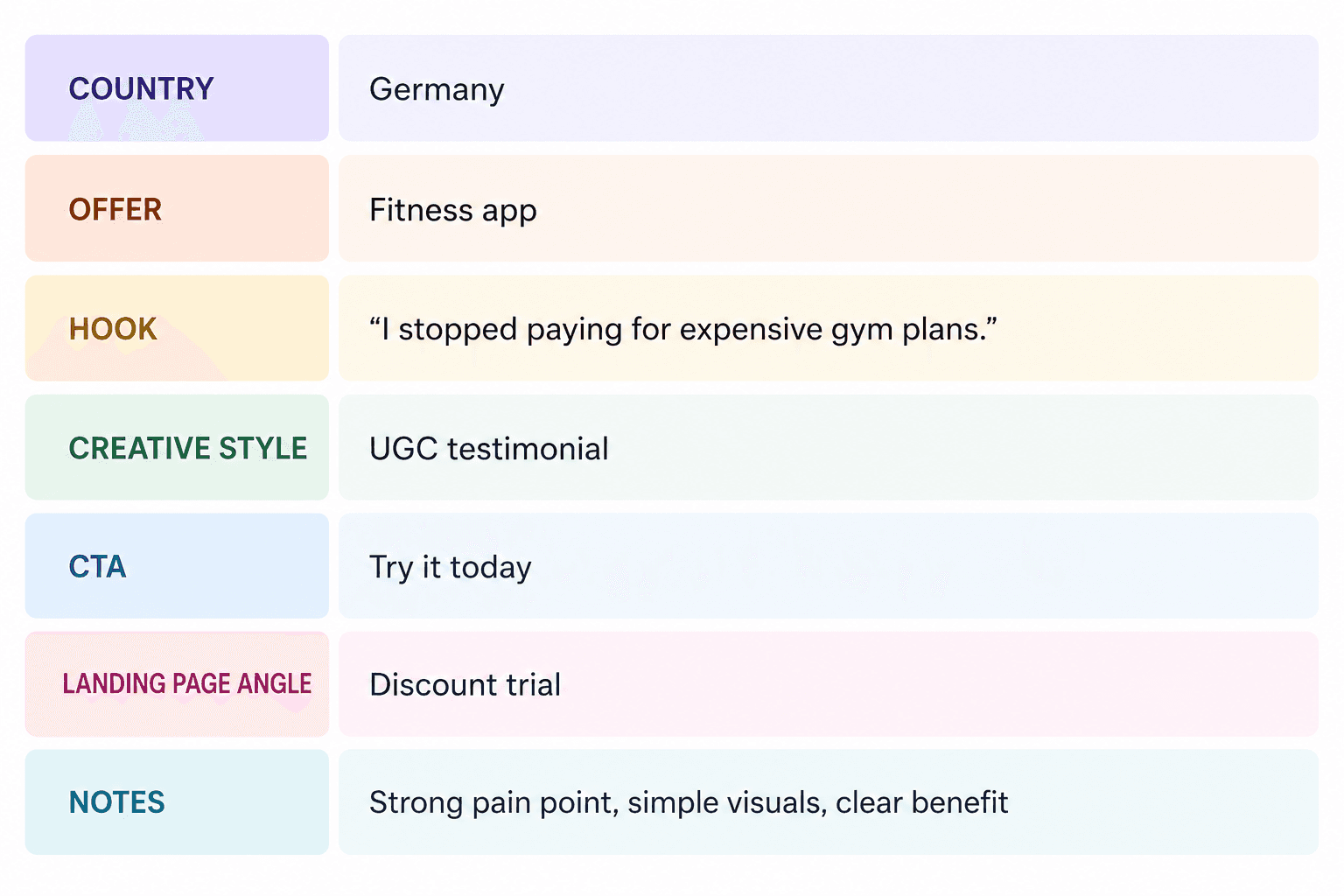
When reviewing TikTok creatives, record the key elements that may influence performance, such as the opening hook, first frame, video length, creator style, on-screen text, voiceover tone, CTA, product demonstration, comment section feedback, and landing page angle. A shared creative research sheet can make this process much easier. For example:
Proxies can also be useful during research and QA. They allow teams to check how landing pages, prices, redirects, and localized content appear from the target country. This is exactly the job PROXIES.SX mobile and residential exits are built for: view the funnel the way a real user in that market sees it, before you spend on traffic.
Step 3: Organize browser profiles by GEO or project
As TikTok campaigns grow, browser organization becomes more important. A team may be managing several countries, clients, offers, landing pages, and ad accounts at the same time. If everything is handled in one browser environment, confusion happens quickly.
A cleaner approach is to create separate browser profiles for each market, client, or campaign. Each profile can keep its own login sessions, bookmarks, notes, language settings, proxy setup, and project context. For example:
| Profile name | Purpose |
|---|---|
| TikTok_DE_FitnessApp_ClientA | Germany campaign for fitness app |
| TikTok_BR_AIStudy_ClientB | Brazil campaign for AI study app |
| TikTok_US_Ecom_Testing | US ecommerce creative testing |
| TikTok_PH_Survey_Research | Philippines survey offer research |
This structure helps team members understand which environment belongs to which project. It also makes handover easier when a new person joins the workflow or when a campaign is moved from one media buyer to another.
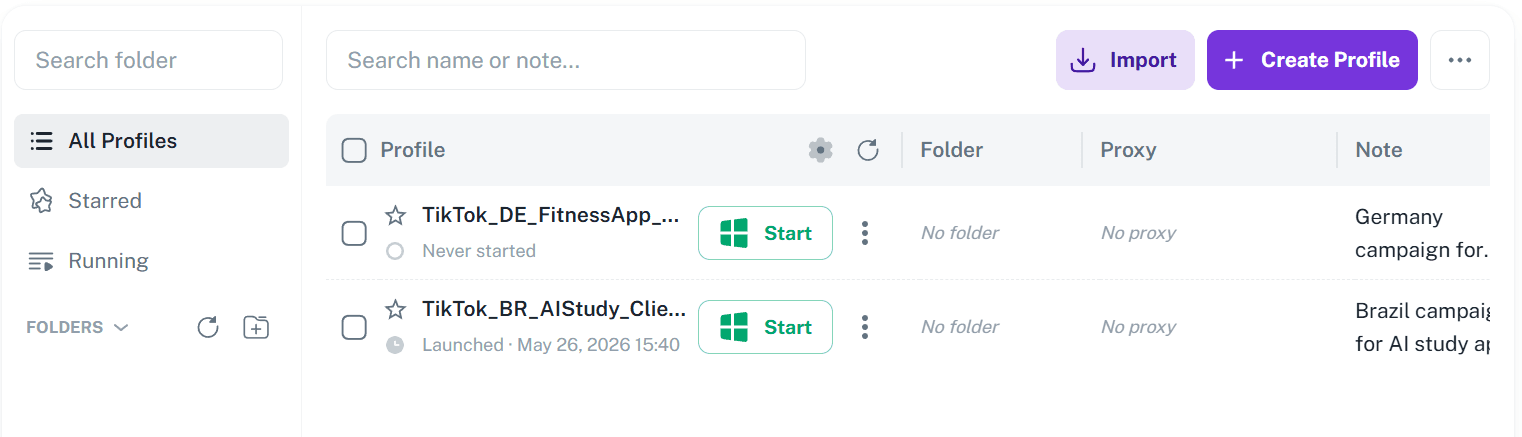
For teams managing multiple TikTok Ads projects, a tool like FlashID can help organize separate browser profiles for different GEOs, clients, or campaigns.
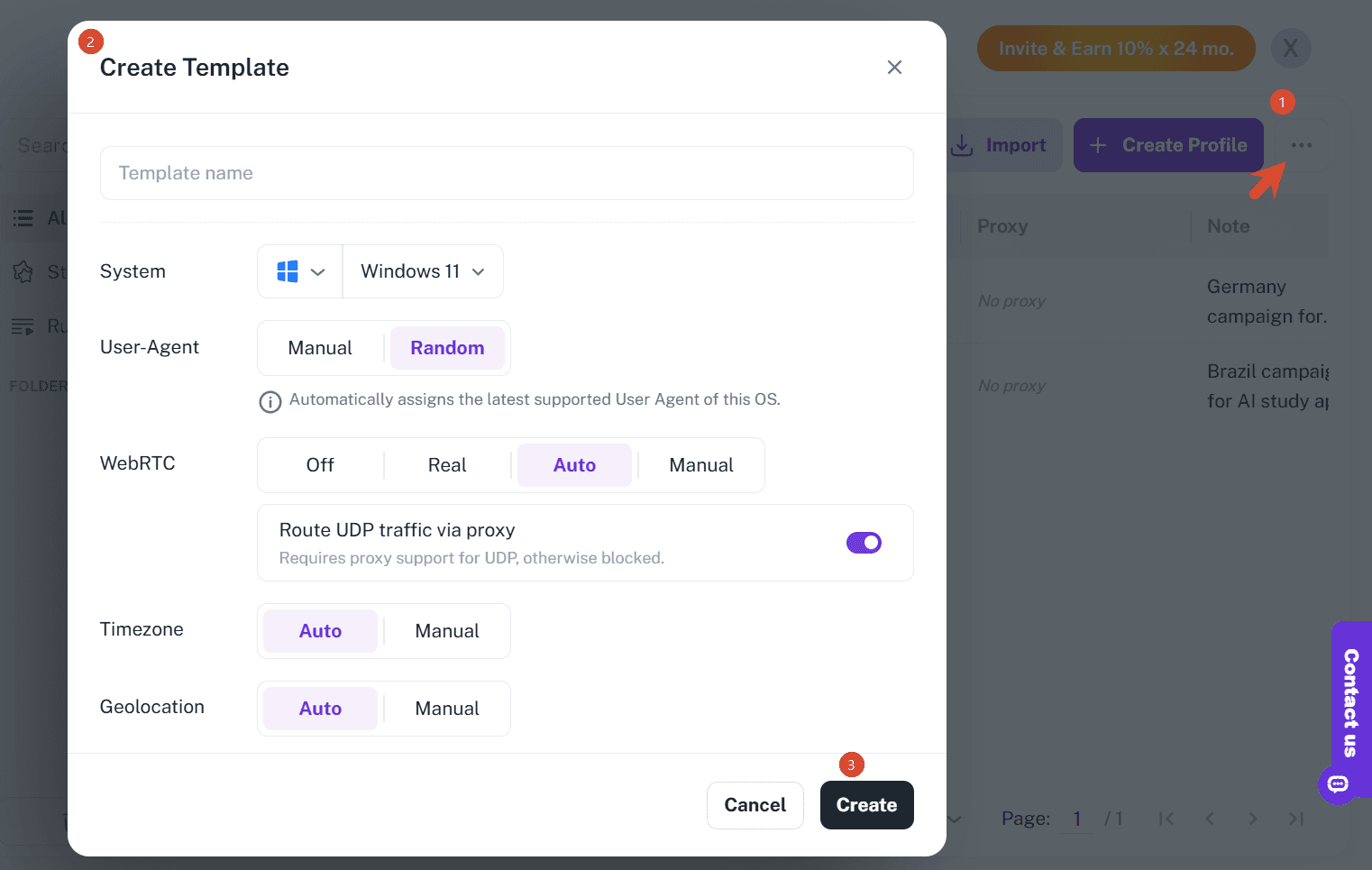
Features like FlashID's Profile Templates can make this process more efficient. Teams can save commonly used Profiles as reusable templates and quickly apply saved fingerprint configurations when creating new Profiles, instead of rebuilding the same setup from scratch every time.
Step 4: Build localized creative variations
Once research is complete, the next step is to create localized creative variations. The key is to avoid random testing. Start with a core angle, then adapt it for each market.
Suppose the offer is an AI productivity app. The main benefit is saving time on repetitive work. That same benefit can be expressed differently depending on the country.
- For the US, the angle may focus on speed and productivity:“I stopped wasting my evenings rewriting the same reports.”
- For Germany, the angle may focus on structure and reliability:“This helped me organize my weekly workflow without missing important tasks.”
- For Brazil, the angle may feel more casual and personal:“I use this to finish work faster and still have time for myself.”
- For Southeast Asia, the angle may focus on mobile convenience and affordability:“A simple app that helps me get more done from my phone.”
The product does not change, but the emotional entry point changes. That is the difference between translation and localization.
AI tools can help in this stage. They can generate hook ideas, script drafts, caption variations, and CTA options. They can also summarize competitor comments and turn user pain points into possible creative angles. However, AI should be used as a draft assistant, not as the final creative decision-maker. TikTok users can easily sense generic scripts. Human review is still needed to make the language natural, remove awkward phrases, and add local context.
Step 5: Set up a simple testing matrix
A testing matrix helps teams understand what they are actually testing. Without a clear matrix, it becomes hard to know why one creative worked and another failed. Here is a simple example:
| Test group | Country | Hook | Video style | CTA | Landing page |
|---|---|---|---|---|---|
| A1 | US | Pain point | UGC testimonial | Learn More | US page |
| A2 | US | Benefit | UGC testimonial | Try Now | US page |
| B1 | Germany | Trust angle | Product demo | Learn More | DE page |
| B2 | Germany | Price angle | Product demo | Try Today | DE page |
| C1 | Brazil | Lifestyle angle | Casual UGC | Start Now | BR page |
If a team changes the hook, video format, CTA, audience, and landing page all at once, the result becomes hard to analyze. Did the creative win because of the hook? The creator style? The landing page? The country? Nobody knows.
A better approach is to control the variables. For example, test three hooks while keeping the same video style and landing page. Or compare UGC videos against product demos while using the same offer and CTA.
Step 6: Track more than CTR
CTR is important, but it should not be the only metric. A TikTok ad can get many clicks and still fail to generate profitable conversions. Affiliate marketers should track the full performance path:
| Metric | What it shows |
|---|---|
| CTR | Whether the creative gets attention |
| CPC | How expensive the traffic is |
| CVR | Whether users convert after clicking |
| CPA | Whether the campaign can be profitable |
| ROI | Whether the campaign is worth scaling |
| Comments | What users think about the offer |
Comments are especially useful. They can reveal doubts, objections, confusion, or unexpected interest. If many users ask the same question, the next creative or landing page should probably answer that question earlier. If users complain about price, the team may need to test a stronger value angle. If users ask whether the product works in their country, the landing page may need clearer regional information.
It is also important to compare results carefully across countries. A higher CPA in one country may still be acceptable if the payout is higher. A low CPC in another market may not matter if the conversion quality is poor.
Step 7: Build a repeatable team workflow
Creative testing becomes much easier when the team has a repeatable process. A weekly workflow could be:
- 1Choose priority GEOs.
- 2Research local TikTok creatives.
- 3Collect hooks, angles, and landing page examples.
- 4Create localized creative briefs.
- 5Prepare browser profiles by market or client.
- 6Produce video variations.
- 7Launch small-budget tests.
- 8Review CTR, CVR, CPA, ROI, and comments.
- 9Keep winners and build the next round of variations.
As the workflow repeats week after week, the value of a structured profile system becomes clearer. Instead of treating each test as an isolated task, teams can standardize how market environments are named, assigned, shared, and reviewed. FlashID can support this process by helping media buyers, researchers, and managers organize separate project environments and work within a clearer team structure.
Practical example: testing one offer in three countries
Imagine an affiliate team is promoting an AI study app. The team wants to test the offer in the United States, Germany, and Brazil. The core benefit is simple: the app helps students organize notes and study faster. But the creative angle should not be exactly the same in every country.
United States
Productivity angle
“I stopped wasting hours rewriting my notes.”
The video shows a student turning messy notes into a clean study plan. The tone is fast, direct, and benefit-driven. The CTA is “Try it before your next exam.”
Germany
Structure and planning angle
“This is how I organize my study week in less than ten minutes.”
The video is calmer. It uses screen recording, simple text, and a clear explanation of the app’s workflow. The message focuses on order, planning, and reliability.
Brazil
Emotional and casual angle
“I wish I had this before my last exam week.”
The video feels more personal. It shows a student using the app on a phone, studying during a commute, and preparing before an exam. The message focuses on convenience and feeling less stressed.
After testing, the team may find that the US creative gets the highest CTR, but the German version brings better conversion quality. The Brazil version may generate many comments, which gives the team useful ideas for the next round of videos. This example shows why multi-GEO creative testing matters. The same offer can work in different countries, but not always with the same message.
Conclusion
TikTok Ads creative testing is not just about producing more videos. For affiliate marketers working across multiple countries, the real advantage comes from building a clear and repeatable system.
A strong workflow includes choosing the right GEOs, researching local creative patterns, checking landing page experiences, organizing browser profiles, using proxies for regional QA, creating localized variations, and tracking results beyond CTR.
The teams that scale successfully are usually not the teams that guess the fastest. They are the teams that learn the fastest. With a structured creative testing workflow, every test becomes more useful, every market becomes easier to understand, and every winning creative becomes a starting point for the next round of growth.
See every market the way a local user sees it
Regional QA is the step most teams skip, and it is the cheapest one. Real 4G/5G mobile and residential exits let you check prices, redirects, currencies and localized copy from inside the target country before you spend a cent on traffic. $4/GB dropping to $2.40/GB at volume, GB never expire, and endpoints are free - so one endpoint per market profile costs nothing extra.
Related reading
This article was contributed by FlashID and published by PROXIES.SX. Product capabilities described for FlashID, including Profile Templates and fingerprint configuration, are the vendor's own statements. Screenshots are supplied by FlashID. The GEO, profile-naming, testing-matrix and metrics tables are illustrative examples rather than benchmark data. Outbound links to FlashID use rel="nofollow sponsored noopener noreferrer".